

How to Divide an Estate Between Siblings



How do you divide your estate among your loved ones? If you have multiple children or siblings you want to distribute your assets to in your will, how do you choose who gets what?
In this article, we give tips and tricks on how to set up a fair distribution of assets, including large assets such as a house or cars, among siblings. We’ll also discuss how estate division negotiation can work among family members and the common challenges of dividing assets among siblings.
Introduction to Estate Division Among Siblings
Distributing your estate between siblings can be challenging because of many factors:
- Emotional attachments: Children or siblings often have strong sentimental connections to family heirlooms, properties, or other assets, which can lead to inherited property disputes when dividing assets.
- Unequal financial situations: It’s possible some members of the family have different financial needs or circumstances, which may create tension if the distribution of assets is seen as unfair.
- Family dynamics: It’s possible that sibling rivalries, resentments, or unresolved conflicts from childhood can resurface during the inheritance process, complicating things.
- Interpretation of parents' wishes: Siblings may disagree on how to interpret their parents’ written will or verbal wishes, which can lead to will challenges and a slower estate settlement.
- Uneven asset distribution: Do all siblings receive the same share? If not, when one sibling receives a larger share of the estate, it can lead to feelings of favouritism and resentment among others.
- Blended families: The presence of step-siblings or half-siblings in the family can add another layer of complexity to your estate and beneficiary situation.
- Personal representative disputes: If someone doesn’t appoint an executor in their will, their family may disagree on who should apply to be estate administrator and be responsible for managing the estate and making decisions.
- Financial pressures: A potentially significant inheritance can bring out greed or desperation in some family members, leading to irrational behaviour.
Does inheritance have to be split evenly?
There is no legal obligation to divide an estate equally among siblings or children in Canada. Legally, you can choose to do whatever you choose with your own assets in your will.
However, in some provinces, a will can be challenged if it does not make adequate, just, and equitable provisions for the proper maintenance and support of the will-maker's spouse or children.
Should each child get the same inheritance?
While splitting your estate evenly between children may be the most “fair” option, it may not be the ideal one for each child’s circumstances.
For example, you may have one child who is less financially stable and could do with extra cash, while another child has told you the only thing they’d like as an inheritance is your car.
Discussing inheritances with your adult children can be a great way to refine how you divide your estate to make everyone happy.
How do you fairly divide family heirlooms?
If you have multiple family heirlooms and the same number of children, you could give each child one heirloom. But if you have an unequal number, it’s worthwhile to discuss which child wants which heirloom. You may also want to consider which beneficiary has the best ability or desire to take care of the heirlooms.
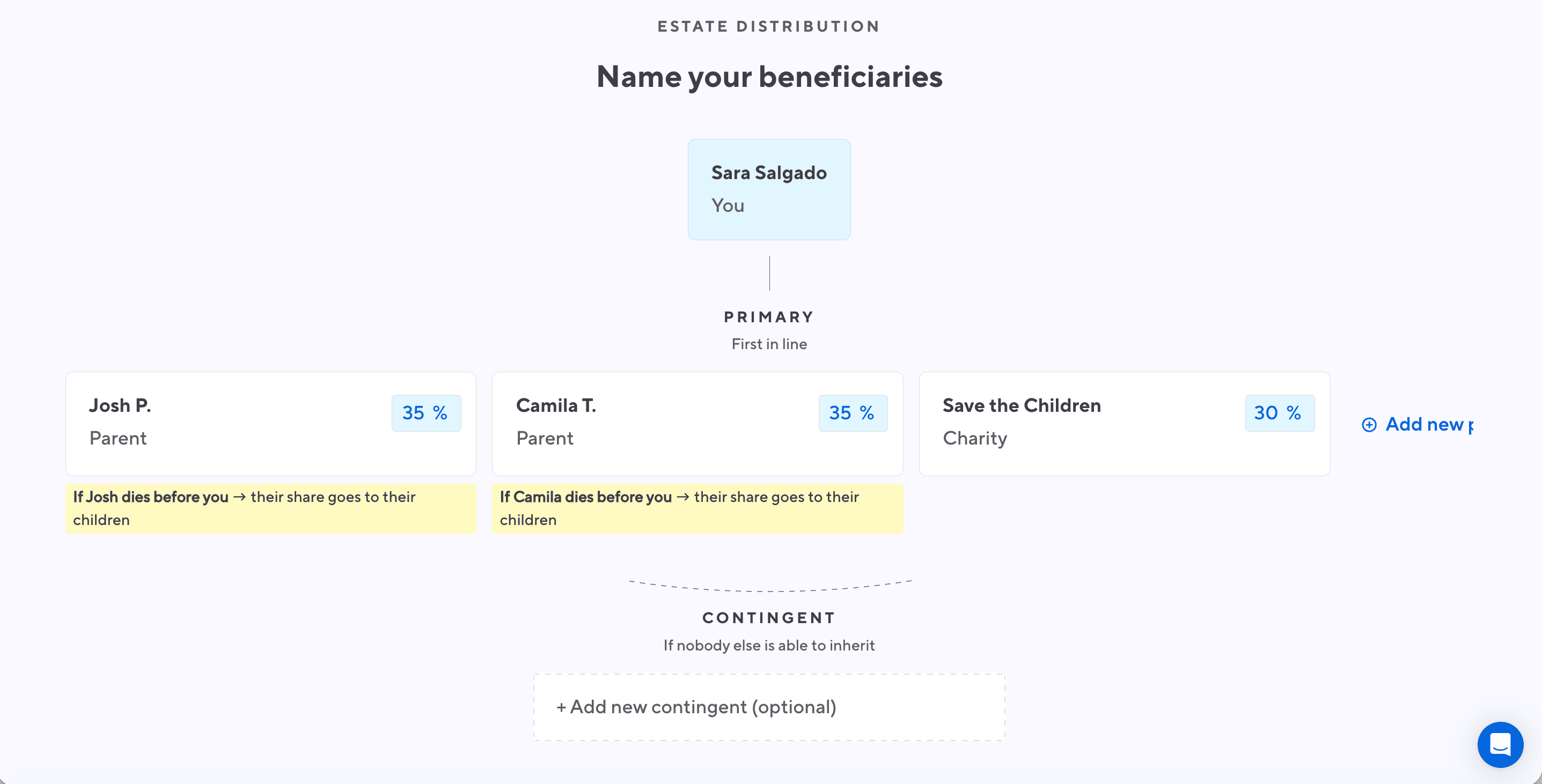
How to split beneficiaries three ways
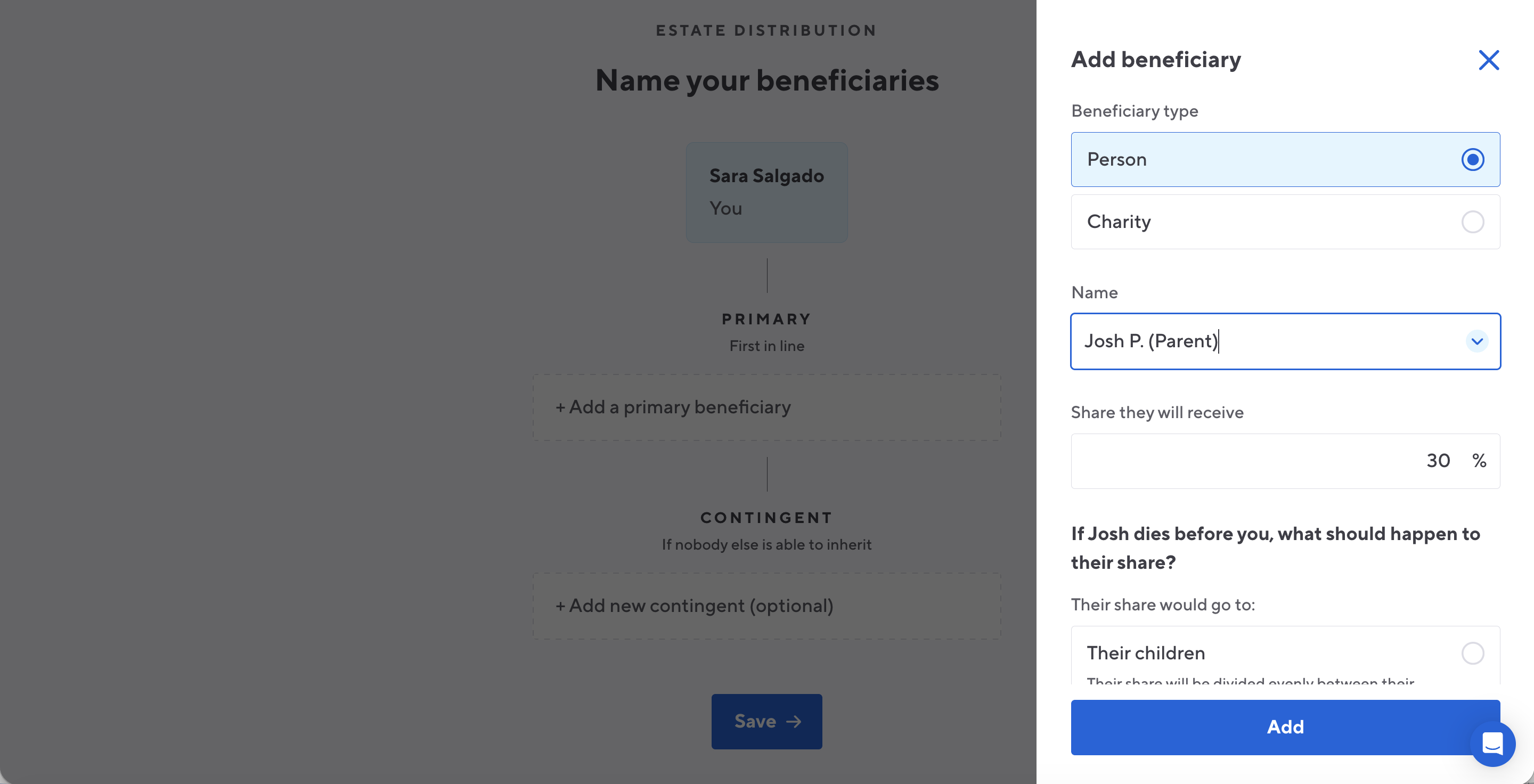
When you add beneficiaries to your Willful will, the platform will ask you to select a contact, specify the share (%) they will receive, and determine what should happen if they pass away before you.
If you’d like to change the estate allocation of each beneficiary, just click on the percentage box and edit the value.
Understanding the Legal Process
An estate plan begins with discussing your wishes with your loved ones and making a will. A last will and testament is created during a person’s lifetime and only comes into effect when the testator (will-maker) has passed away.
If the testator named an executor in their will, their executor is responsible for finding the will, notifying the government about the person’s passing, and beginning to organize the deceased’s funeral.
Next, the executor will carry out their estate settlement responsibilities, which include:
- Planning the funeral and burial
- Paying off estate debts
- Advertising for creditors to collect any debt that’s owed to the estate
- Distributing assets to beneficiaries named in the will
- Selling property and/or businesses (if necessary)
- Filing final tax returns
- Communicating with heirs and beneficiaries
It’s also important to remember that not all estates can be settled within a year. Some more complex estates may take longer.
Learn more about the time it takes to settle an estate →
Problems with Siblings Settling Estates
Common issues with siblings settling estates often include disagreements over asset distribution, who's been appointed as the executor or estate administrator, and if siblings had received unequal inheritances. Siblings may argue over the sale or retention of family property, challenge the validity of the will, or accuse each other of exerting undue influence over the deceased parent.
Additionally, issues may arise when one sibling has received more financial support during the parent's lifetime or has a larger stake in a family business.
When siblings are mourning the loss of their family member and are stressed over the estate distribution, these issues can become more predominant, which is why managing family dynamics and facilitating positive communication is so important.
If you're here for tips on how to talk to your siblings about splitting inheritance, look no further. Here's how to tackle inheritance conflict resolution or other issues with family members and the estate:
- Choose a neutral setting that encourages dialogue, where everyone feels comfortable expressing their thoughts and concerns openly.
- Practice active listening by encouraging siblings to take an empathetic stance. Focus on common goals as a family unit and identify shared objectives like preserving family assets.
- Executors should provide relevant information about the estate plan, assets, liabilities, and distribution plans, maintaining regular check-ins to build trust and keep everyone informed.
- If there’s a topic you know will cause conflict, approach it with open dialogue, sensitivity, and empathy. If there are valid reasons for unequal distribution, make sure they are clearly explained and documented to prevent misunderstandings in the future.
- If necessary, seek professional guidance, such as an estate planning attorney or mediator, to provide expert advice and facilitate discussions with the family, especially for complex legal or financial issues.
Learn more: estate planning vs a will →

The easiest way to create your legal will. No lawyer required.
Start your will today →Options for Dividing Large Assets
If, for example, you are inheriting a house with siblings in Canada, all siblings have to unanimously decide what to do with it and how to divide the house in a way that feels equal to everyone. Here are some options on what to do.
Option 1: Keep the property
Option 2: Sell the property
Methods of equalization
When negotiating how to deal with assets like an inherited home among siblings, here are some estate equalization techniques you can use to keep everyone on equal footing or come to a collective understanding about the estate and their respective inheritances.
Cash Payment
One or more siblings can buy out others’ shares of the property by paying them the equivalent cash value of their share. This option requires that you appraise the property to determine its fair market value.
The siblings being bought out would be considered to have disposed of their share of the property and experienced a capital gain. This means they might be affected by capital gains tax.
Shared Ownership
Siblings can co-own the property, sharing usage and expenses. To make sure everything is equal and avoid conflicts, you should create clear agreements on the usage schedule for the property, how you share expenses, and how you make decisions about the property in the future.
Deferred Sale
This means the property is kept for a set period, like until market conditions improve, and then sold. The proceeds are then divided among the property's beneficiaries. Like the shared ownership option, there may need to be a sibling agreement on the property, including how the property is used and maintained during the waiting time.
Offsetting Assets
If the estate includes other assets, those assets can be used to balance the value of the property. For example, one sibling may receive the property while others receive cash or other assets of equivalent value.
Partitioning the Property
If possible, the property can also be physically divided into separate units, each allocated to different beneficiaries or siblings. Note that this option is more common in cases of inherited land rather than a family home.
What is the fairest way to divide inheritance?
“Fair” could mean different things to different members of the family. That’s why it’s important for each beneficiary to speak their mind and state what they see as an ideal fair scenario. Then, you can work to find the middle ground.
Case Studies and Real-Life Examples
The Role of Early Discussions and Clear Wills
Talking with your loved ones about your own final wishes helps them in many ways.
First, it gives them an idea of how you’d like your estate to be distributed.
Second, they understand their roles in the settlement process, such as choosing to take on the roles of executors, estate trustees, guardians, or beneficiaries. This can be especially helpful if your estate plan includes siblings who may not all have the same roles in your will.
Third, through conversations with you, your loved ones can also begin to think about their own final wishes and estate plans.
Even if you're on the other side of things, and are inheriting assets with your siblings, having empathetic discussions gives you and your loved ones peace of mind for what the future may hold.
This content has been reviewed by Canadian estate planning experts or legal professionals. Our editorial team is committed to ensuring the accuracy and currency of content.